
23 Mar , 2026 By : Debdeep Gupta
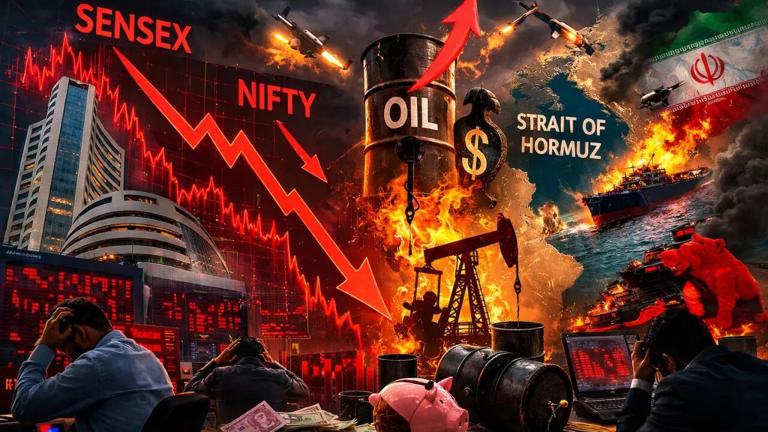
The benchmark equity indices Sensex and Nifty declined sharply on Monday, tracking weak global cues as the West Asia conflict entered its fourth week and pushed crude oil prices higher.
The Sensex fell 1,904.61 points or 2.5 percent to 72,628.35 in trade. The broader Nifty dropped 610.35 points or 2.6 percent to its lowest level since April 9, 2025 at 22,504.15.
The volatility index, which gauges market expectations of near-term volatility, surged 15 percent to the 26 level, its highest since early June 2024.
The benchmark Nifty50 has declined 10 percent since the US-Iran war began on February 28 and is down 14 percent from its lifetime high.
6 key factors behind market decline
The benchmark indices Sensex and Nifty fell sharply on Monday, tracking weak global cues as the West Asia conflict entered its fourth week and pushed crude oil prices higher. Sustained foreign fund outflows also weighed on investor sentiment.
At 10:45 am, the Sensex was down 1,785.12 points or 2.4 percent at 72,747.84. The broader Nifty declined to 22,547.35, down 567.15 points or 2.45 percent, its lowest level since April 9, 2025. Market breadth remained weak, as bout 521 shares advanced, 3265 shares declined and 138 shares unchanged.
Among stocks, HDFC Bank fell about 2.5 percent after sliding 7.4 percent in the previous two sessions following the resignation of its part-time chairman Atanu Chakraborty. State Bank of India dropped 3.6 percent after receiving a tax demand of Rs 6,337 crore from the Income Tax Department for the assessment year 2024.
All 16 major sectoral indices were in the red. The broader indices also saw sharp losses, with the Nifty smallcap100 and Nifty midcap100 falling 3.82 percent and 3.45 percent, respectively.
Key factors behind the decline
1) Elevated crude prices: Brent crude rose 0.62 percent to USD 112.9 per barrel, remaining above the USD 110 mark amid concerns over supply disruptions linked to the ongoing conflict. Brent crude hovering near $113 a barrel poses a particular challenge for India, one of the world's largest oil importers. Persistently high oil prices fuel inflation, widen external imbalances, weaken the rupee, and extend foreign capital outflows.
2) Persistent FPI selling: Foreign portfolio investors continued to offload equities amid global uncertainty. FPIs have remained net sellers throughout March, with total outflows of Rs 90,152 crore till March 20. Analysts said concerns over global growth, rising crude prices and relatively lower returns from domestic markets have impacted sentiment.
3) Rise in India VIX: The volatility index, which gauges market expectations of near-term volatility, surged 15 percent to the 26 level, its highest since early June 2024. A higher VIX indicates increased uncertainty and risk aversion among investors, often leading to sharp market swings and selling pressure.
4) Geopolitical tensions: Escalating tensions between the United States and Iran added to market jitters. Reports of threats related to the Strait of Hormuz and potential retaliation have heightened fears of disruption in global energy supplies. Analysts said the lack of clarity on the duration and outcome of the conflict has kept markets on edge.
5) Weak global cues: Asian markets traded sharply lower, with South Korea’s Kospi plunging nearly 6 percent and Japan’s Nikkei declining around 4.6 percent. US markets ended significantly lower on Friday, while Wall Street futures were down about 1.5 percent, indicating a weak start on Monday.
6) Rupee at record low: The rupee fell 41 paise to hit a record low of 93.94 against the US dollar in early trade, pressured by rising crude prices and sustained foreign fund outflows. Weakness in domestic equities further weighed on the currency. Bond yields also rose, reflecting pressure from global and domestic factors.
Analysts said the Nifty may test the 22,560 level in the near term before any consolidation. On the upside, a move above 23,179 would be required to trigger a recovery.
Anand James, Chief Market Strategist at Geojit Investments, said "The widening of the lower bollinger band, following wild moves last week, forces us to bring 22000 back into the picture. The first leg of this down move would aim for 22560, before any consolidation emerges. Alternatively, reversal attempts will require a direct rise above 23179, to attract upside momentum."
Escalating tensions between the United States and Iran weighed on investor sentiment. Reports of threats related to the Strait of Hormuz and possible retaliation have raised concerns over disruption in global energy supplies.
Analysts said the lack of clarity on the duration and outcome of the conflict has kept markets on edge.
Anand James, Chief Market Strategist at Geojit Investments, said the widening of the lower Bollinger band following volatile moves last week has brought the 22,000 level back into focus.
He said the first leg of the decline could target 22,560 before any consolidation, while reversal attempts would require a rise above 23,179 to gain momentum.
Analysts at Choice Broking said it would be prudent to accumulate fundamentally strong stocks on meaningful declines rather than chase short-term bounces. Fresh long positions should ideally be considered only after the Nifty stages a decisive recovery and sustains above the 24,500–25,000 mark, indicating improving sentiment and the possibility of a stable recovery.
Meanwhile, the rupee fell 41 paise to hit a record low of 93.94 against the US dollar in early trade, pressured by rising crude prices and continued foreign fund outflows. Weak domestic equities further weighed on the currency. Bond yields also moved higher, reflecting pressure from global and domestic factors.






























0 Comment