
03 Jul , 2024 By : Debdeep Gupta

Nifty Trend
The market turned rangebound after hitting a new high and closed flat with a negative bias on July 2. The Nifty 50 climbed above 24,200 for the first time, before ending 18 points down at 24,124. The index is likely to consolidate as long as it stays below 24,200 on a closing basis, with immediate support at 24,000. If it closes and sustains above 24,200, then 24,500 is the level to watch. Here are 15 data points we have collated to help you spot profitable trades:
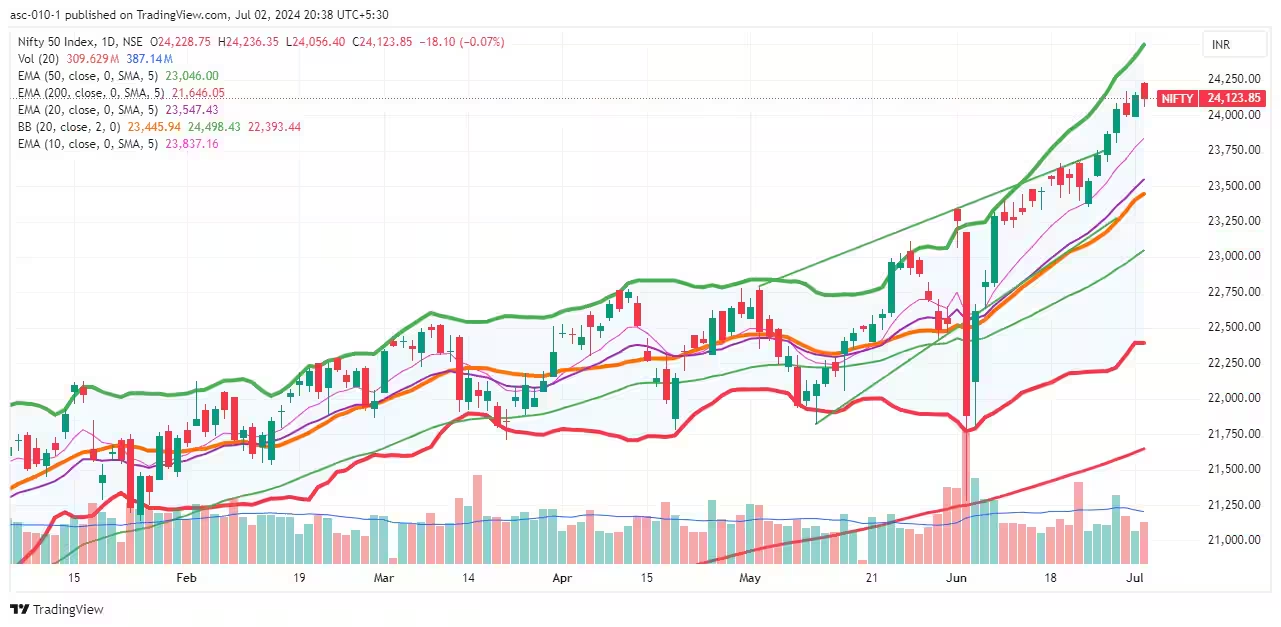
Here are 15 data points we have collated to help you spot profitable trades:
1) Key Levels For The Nifty 50
Resistance based on pivot points: 24,208, 24,250, and 24,319
Support based on pivot points: 24,070, 24,028, and 23,959
Special Formation: The Nifty 50 formed a bearish candlestick pattern on the daily charts, although there was a higher high-higher low formation. The momentum indicators RSI (Relative Strength Index) and MACD (Moving Average Convergence Divergence) remained positive on the higher timeframes.
2) Key Levels For The Bank Nifty
Resistance based on pivot points: 52,649, 52,845, and 53,163
Support based on pivot points: 52,013, 51,817, and 51,499
Resistance based on Fibonacci retracement: 53,227, 54,257
Support based on Fibonacci retracement: 51,503, 50,473
Special Formation: The Bank Nifty formed a long bearish candlestick pattern, resembling a Bearish Engulfing pattern on the daily charts, and also closed below the previous day's low with a negative bias in the momentum indicator RSI, indicating some caution.
3) Nifty Call Options Data
According to the weekly options data, the 25,000 strike holds the maximum open interest (with 1.18 crore contracts). This level can act as a key resistance level for the Nifty in the short term. It was followed by the 24,500 strike (79.52 lakh contracts) and the 24,800 strike (52.03 lakh contracts).
Maximum Call writing was observed at the 24,500 strike, which saw an addition of 11.44 lakh contracts, followed by the 24,200 and 24,600 strikes, which added 11.05 lakh and 10.92 lakh contracts, respectively. The maximum Call unwinding was seen at the 24,700 strike, which shed 6.35 lakh contracts, followed by the 24,000 and 25,000 strikes, which shed 4.88 lakh and 1.03 lakh contracts, respectively.
4) Nifty Put Options Data
On the Put side, the maximum open interest was observed at the 24,000 strike (with 77.4 lakh contracts), which can act as a key support level for the Nifty. It was followed by the 23,500 strike (64.15 lakh contracts) and the 23,000 strike (61.2 lakh contracts).
The maximum Put writing was visible at the 23,400 strike, which saw an addition of 10.06 lakh contracts, followed by the 23,800 and 23,600 strikes, with 7.4 lakh and 6.98 lakh contracts added, respectively. Put unwinding was observed at the 23,100 strikes, which shed 7.59 lakh contracts, followed by 22,900 and 23,000 strikes, which shed 5.45 lakh and 3.88 lakh contracts respectively.
5) Bank Nifty Call Options Data
According to the weekly options data, the maximum Call open interest was seen at the 53,000 strike, with 56.84 lakh contracts. This can act as a key resistance level for the index in the short term. It was followed by the 54,000 strike (46.77 lakh contracts) and the 53,500 strike (36.3 lakh contracts).
Maximum Call writing was visible at the 54,000 strikes (with the addition of 22.03 lakh contracts), followed by the 53,000 strikes (19.26 lakh contracts) and the 53,500 strikes (15.85 lakh contracts), while the maximum Call unwinding was seen at the 51,500 strike, (which shed 53,070 contracts), followed by the 50,500 strike (36,960 contracts), and the 51,000 strike (26,880 contracts).
6) Bank Nifty Put Options Data
On the Put side, the 52,000 strike holds the maximum open interest (with 26.18 lakh contracts), which can act as a key support level for the index. This was followed by the 51,000 strike (25.93 lakh contracts) and the 50,500 strike (24.26 lakh contracts).
The maximum Put writing was observed at the 50,700 strikes (which added 15.51 lakh contracts), followed by the 50,500 strikes (8.61 lakh contracts) and the 51,000 strikes (8.54 lakh contracts), while Put unwinding was seen at the 52,600 strikes, which shed 7.33 lakh contracts, followed by the 52,500 and 52,400 strikes, which shed 5.83 lahks and 5.54 lakh contracts, respectively.
7) Put-Call Ratio
The Nifty Put-Call ratio (PCR), which indicates the mood of the market, declined to 1.15 on July 2 from 1.21 levels in the previous session.
The increasing PCR, or being higher than 0.7 or surpassing 1, means traders are selling more Put options than Call options, which generally indicates the firming up of a bullish sentiment in the market. If the ratio falls below 0.7 or moves towards 0.5, then it indicates selling in Calls is higher than selling in Puts, reflecting a bearish mood in the market.
8) India VIX
The volatility sustained below the 10-day EMA (Exponential Moving Average) as well as the 200-day EMA, which is favorable for bulls. India VIX, the fear index, fell by 1.37 percent to 13.64 from 13.83 levels.
9) Stocks Under F&O Ban
Securities banned under the F&O segment include companies where derivative contracts cross 95 percent of the market-wide position limit.
Stocks added to F&O ban: Nil
Stocks retained in F&O ban: India Cements, Indus Towers
Stocks removed from F&O ban: Nil































0 Comment