
14 Nov , 2022 By : Kaushiki Mehta
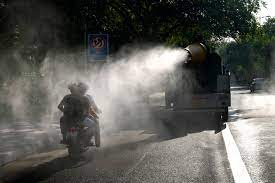
NEW DELHI — As Diwali fireworks pierced the air and lit up the skies of India’s capital region last month, 4-year-old Abhinandan was struggling to breathe.
Air quality is generally poor in New Delhi, the world’s most polluted capital, but it is often made worse by the annual celebrations of Diwali, one of India’s most important Hindu festivals. As people burst more and more firecrackers, Abhinandan began vomiting and coughing up mucus.
“His health started to get worse after the October rains as farmers turned to burning stubble, but it went out of control on Diwali night,” his father, journalist Abhishek Anand, said.
Anand said his son’s respiratory issues, which he developed when he was a year old, resurfaced this year after vanishing during the coronavirus pandemic, when lockdowns curbed India’s economic activity and the resulting pollution.
After the fireworks subsided, the air only got worse. By the first week of November, New Delhi’s air quality index was 472, high enough to affect healthy people while having a serious impact on those with existing conditions.
In some areas of the city, the reading exceeded 800, according to the Delhi Pollution Control Committee, a regulatory body. New Delhi’s 20 million residents weren’t breathing air so much as smoke.
Garima Sudhan, a student at Delhi University, woke up with a sore throat and anxiety.
“It was difficult to breathe after Diwali, even indoors,” she said. “I believe with such a high level of pollution in the city, it is becoming hard to stay mentally calm. I’m finding it hard to sleep and the restlessness has increased.”
This was the first time in three years Sudhan, who is from the northern region of Jammu and Kashmir, had spent Diwali in the capital.
“I usually try to go home because of the fear of pollution in the city post-Diwali,” she said. “But it gets worse every passing year.”
Officials had banned fireworks in the city ahead of the holiday, even threatening up to six months in jail for their unauthorized use, but sales in the surrounding region thrived in anticipation of the first Diwali celebrations without Covid restrictions.
“The government does nothing about it,” Sudhan said. “They let the city choke.”
Gopal Rai, Delhi’s environment minister, did not respond to an emailed request for a comment.Garima Sudhan, a student at Delhi University, woke up with a sore throat and anxiety.
“It was difficult to breathe after Diwali, even indoors,” she said. “I believe with such a high level of pollution in the city, it is becoming hard to stay mentally calm. I’m finding it hard to sleep and the restlessness has increased.”
This was the first time in three years Sudhan, who is from the northern region of Jammu and Kashmir, had spent Diwali in the capital.
“I usually try to go home because of the fear of pollution in the city post-Diwali,” she said. “But it gets worse every passing year.”
Officials had banned fireworks in the city ahead of the holiday, even threatening up to six months in jail for their unauthorized use, but sales in the surrounding region thrived in anticipation of the first Diwali celebrations without Covid restrictions.
“The government does nothing about it,” Sudhan said. “They let the city choke.”
Gopal Rai, Delhi’s environment minister, did not respond to an emailed request for a comment.
Garima Sudhan, a student at Delhi University, woke up with a sore throat and anxiety.
“It was difficult to breathe after Diwali, even indoors,” she said. “I believe with such a high level of pollution in the city, it is becoming hard to stay mentally calm. I’m finding it hard to sleep and the restlessness has increased.”
This was the first time in three years Sudhan, who is from the northern region of Jammu and Kashmir, had spent Diwali in the capital.
“I usually try to go home because of the fear of pollution in the city post-Diwali,” she said. “But it gets worse every passing year.”
Officials had banned fireworks in the city ahead of the holiday, even threatening up to six months in jail for their unauthorized use, but sales in the surrounding region thrived in anticipation of the first Diwali celebrations without Covid restrictions.
“The government does nothing about it,” Sudhan said. “They let the city choke.”
Gopal Rai, Delhi’s environment minister, did not respond to an emailed request for a comment.
Moksh Saigal, a high school student in the Saket neighborhood of New Delhi, said the closures affected older students taking important exams, as well as younger ones who have already missed years of classroom time because of the pandemic.
Though pollution worsens every year after Diwali, “it is only during this time the government realizes that the air is polluted,” the 16-year-old said. “The whole year round, they take no measures to ensure air quality.”
Solving New Delhi’s pollution problem requires a multipronged approach and stricter enforcement, said Vivek Chattopadhyaya, a program manager for the Air Pollution Control Unit at the Center for Science and Environment, an advocacy group based in the city.
“You need to have better emissions standards for industries and power plants,” he said. “Then finding a solution for stubble burning, [and] improving public transport is also an issue.”
Anand said he worries about the long-term effect the pollution is having on Abhinandan’s health, turning to doctors in his family for help.
“They are helping me in developing his lungs,” he said. “It is a very sad situation. But that is how he is surviving now.”












0 Comment