
19 Jul , 2025 By : RAJIV DUTTA
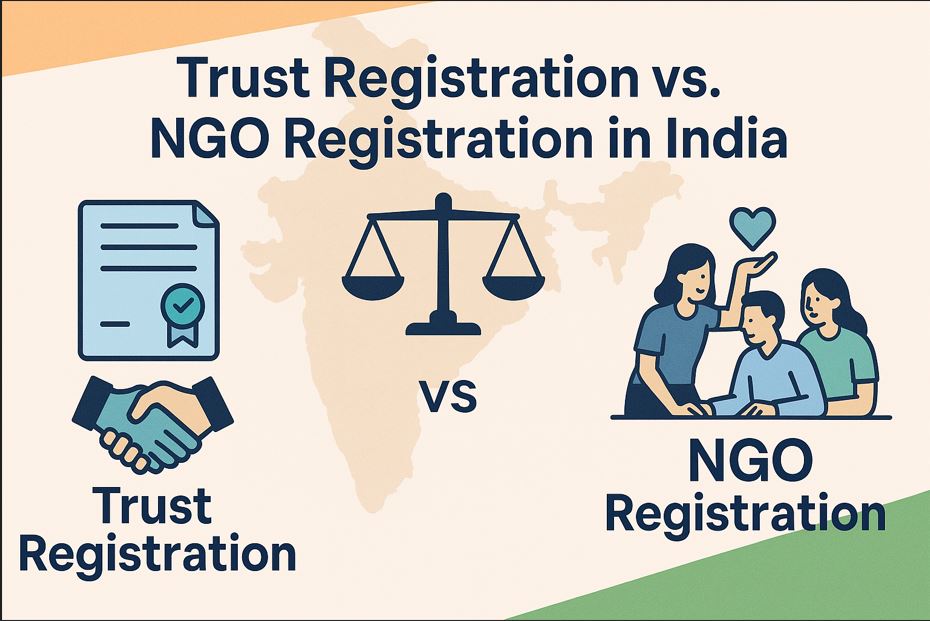
Starting a social initiative in India is a commendable endeavor, but navigating
the legal landscape to establish your organization can be a complex task. One
of the primary decisions you'll face is choosing the right legal structure:
should you opt for a Trust or an NGO (which typically refers to a Society or a
Section 8 Company)? Understanding the nuances of each can significantly impact
your mission's long-term success, governance, and funding opportunities.
At its core, both structures aim to serve a public purpose, but they differ in
their formation, governance, and regulatory compliance. Making an informed
choice at the outset can save you significant time and resources later.
Understanding Trust Registration in India
A
Trust is primarily governed by the Indian Trusts Act, 1882 (for private trusts)
or state-specific public trust acts (for public charitable trusts). It is
created through a Trust Deed, which is a legal document outlining the trust's
objectives, the powers of the trustees, and the beneficiaries.
Key Characteristics of Trusts:
1. Formation: Relatively simpler to establish. A Trust Deed is
executed and registered with the Sub-Registrar of Assurances.
2. Governing Law: Indian Trusts Act, 1882 (for private trusts)
or respective state Public Trusts Acts (e.g., Bombay Public Trusts Act, 1950,
in Maharashtra).
3. Management: Managed by a Board of Trustees.
4. Flexibility: Generally, less stringent compliance
requirements compared to Section 8 Companies, though public trusts still have
significant obligations.
5. Perpetuity: Can have perpetual existence if structured
correctly.
When to Consider a Trust:
1. If your initiative is relatively small-scale or localized.
2. If you prioritize simpler setup and compliance procedures initially.
3. For family-oriented charitable activities or specific endowments.
For a detailed guide on the process and requirements, you can learn more about trust registration.
Understanding NGO Registration (Societies & Section 8
Companies)
The
term "NGO" is an umbrella term that commonly refers to two other
legal structures for non-profit organizations in India: Societies and Section 8
Companies.
Societies
Societies
are registered under the Societies Registration Act, 1860, or respective
state-level societies registration acts. They are typically formed for the
promotion of literature, science, or the fine arts, or for the diffusion of
useful knowledge, charitable purposes, etc.
Key Characteristics of Societies:
1. Formation: Requires a Memorandum of Association and Rules & Regulations,
registered with the Registrar of Societies.
2. Membership: Needs at least seven members to form a society.
3. Governing Body: Managed by a Governing Body or Managing Committee elected by
its members.
4. Flexibility: More formal than a Trust, with defined membership rules.
Section 8 Companies
A
Section 8 Company is a non-profit company registered under the Companies Act,
2013 (formerly Section 25 of the Companies Act, 1956). These companies are
formed for promoting commerce, art, science, sports, education, research,
social welfare, religion, charity, protection of environment or any such other
object, provided they intend to apply their profits, if any, or other income in
promoting their objects and prohibit the payment of any dividend to their
members.
Key Characteristics of Section 8 Companies:
1. Formation: Registered with the Ministry of Corporate Affairs (MCA) and
requires a minimum of two directors (for a Private Limited Section 8 Company)
or seven members (for a Public Limited Section 8 Company).
2. Governing Law: Companies Act, 2013.
3. Credibility: Often perceived as more credible due to stricter compliance and
transparency requirements under the Companies Act.
4. Funding: Preferred by many corporate donors and international funders due to
higher governance standards.
5. Compliance: Subject to rigorous annual compliance similar to commercial
companies.
When to Consider an NGO (Society or Section 8 Company):
1. If your initiative aims for a larger scale, national, or even international
presence.
2. If you anticipate significant funding from corporations, government grants,
or international bodies.
3. If you prefer a more formal, structured governance model with clear
accountability.
For
comprehensive details on how to register these entities, you can find
information on NGO registration.
Making the Right Choice
The decision between a Trust and an NGO largely depends on your organization's
vision, scale, funding strategy, and desired level of governance and compliance.
1. Trusts offer
simplicity and are often suitable for smaller, localized, or family-run
charitable initiatives.
2. Societies provide a good balance for groups with a
membership structure and specific objectives, often used for cultural, educational,
or sports bodies.
3. Section 8 Companies offer the highest level of credibility,
transparency, and formal structure, making them ideal for large-scale social
enterprises, those seeking significant corporate or international funding, and
those requiring robust governance.
Before making a final decision, it is highly advisable to consult with legal and financial experts who can provide tailored advice based on your specific objectives and long-term goals. Choosing the right legal framework is the cornerstone of building a sustainable and impactful social initiative in India.
























0 Comment